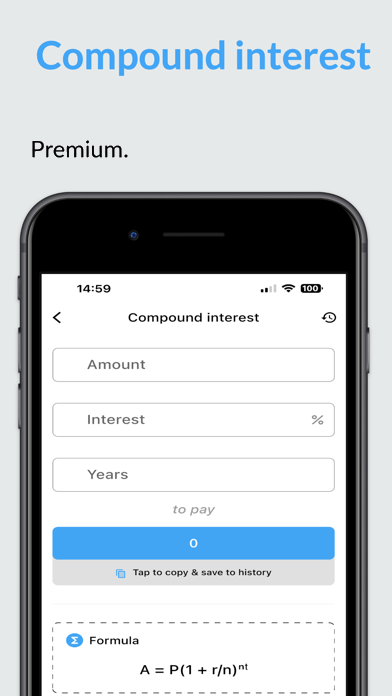
Use the compound interest calculator app on your phone
Download The Percentage Calculator from the App Store or Google Play. Choose compound interest from the calculator list and unlock Premium to use this feature. The four basic percentage modes are free with ads.
To calculate compound interest for your scenario, follow the app’s field labels and check the time units before entering your numbers. Keep the annual rate and the compounding period consistent. Read the formula below to understand how a fixed starting amount grows when interest is added to the balance.
How to calculate compound interest
In A = P(1 + r/n)^(nt), A is the ending balance and P is the starting principal. The annual interest rate r is a decimal, n is the number of compounding periods per year, and t is the time in years. Interest earned is A − P when there are no additional deposits or withdrawals.
For 1,000 at 5% compounded annually, the first year adds 50 and ends at 1,050. The second year adds 5% of 1,050, which is 52.50. The final balance is 1,102.50, with total interest of 102.50.
| Year | Starting balance | Interest at 5% | Ending balance |
|---|
| 1 | 1,000.00 | 50.00 | 1,050.00 |
| 2 | 1,050.00 | 52.50 | 1,102.50 |
Annual rate, compounding frequency and contributions
Annual compounding uses n = 1. Monthly compounding uses n = 12, with the nominal annual rate divided into twelve periodic rates. For a fixed positive nominal annual rate, more frequent compounding increases the calculated ending balance when the other assumptions stay the same.
Regular deposits need an additional cash-flow calculation. Their amount and timing affect how long each deposit earns interest. The formula shown here covers one starting amount without contributions. Check the app’s fields for the scenario you want to calculate.
The SEC’s Investor.gov compound interest calculator identifies starting amount, contributions, time, estimated annual rate and compounding frequency as separate factors in a projection.
Read a growth estimate with its assumptions
A constant-rate calculation assumes the rate remains unchanged. Fees, taxes, withdrawals and inflation can affect the money available or its purchasing power. An investment’s actual return can vary and may be negative.
Simple interest on 1,000 at 5% for two years is 100, giving a balance of 1,100. The compound example earns 2.50 more because the first year’s interest also earns interest in year two.
Use the percentage change calculator to compare a known starting and ending balance. A growth percentage alone does not establish the annual interest rate when contributions, withdrawals or multiple years are involved. The interest rate page explains why the model and period matter.